Cart
0

"Gallery-wrapped" appears on almost every canvas listing online, and it is worth knowing what it describes, because the difference between a real wrap and a cheap one shows up on your wall within a year.
The construction
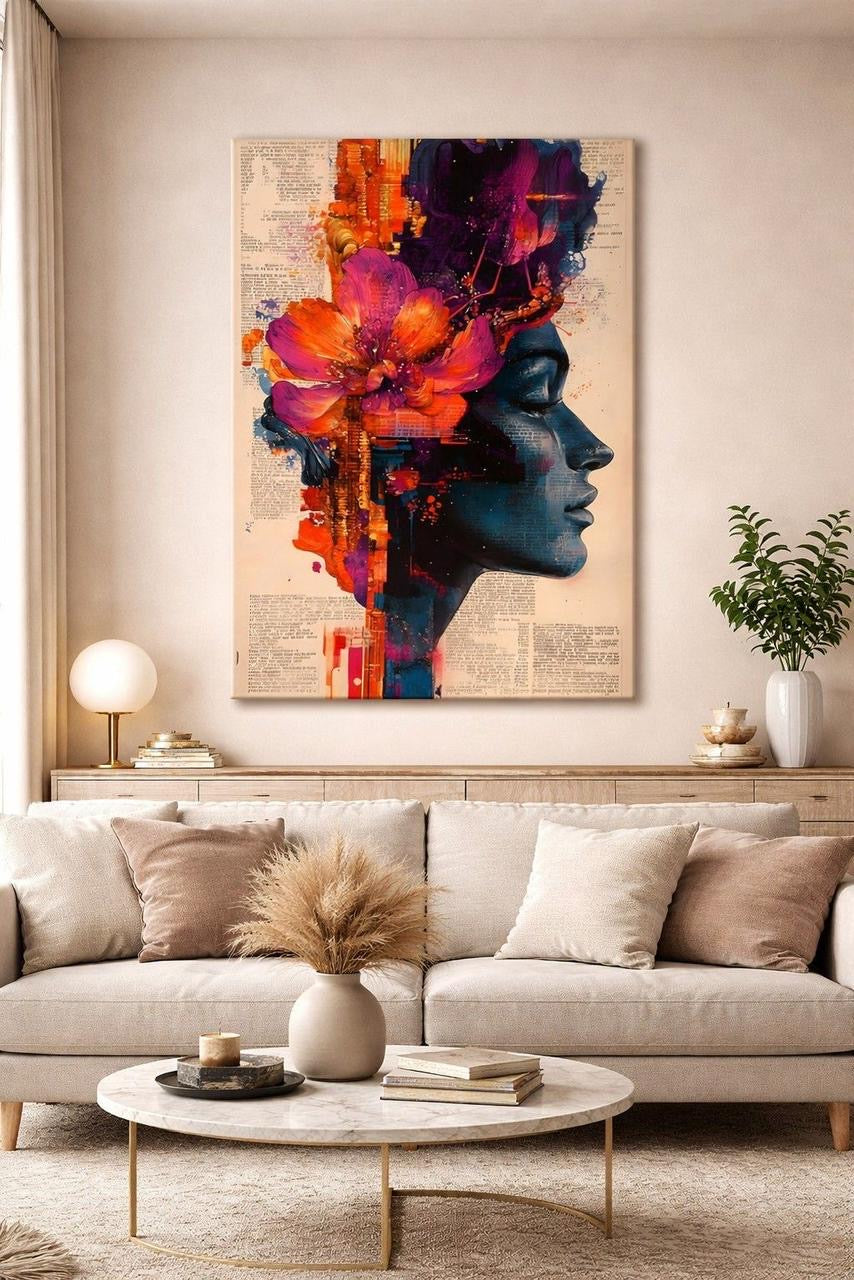
A gallery-wrapped canvas is printed on a single piece of canvas that is stretched over a wooden frame — the stretcher bars — and secured on the back, not the sides. The image continues around the edge of the frame, so when you look at the canvas from an angle you see artwork, not a strip of raw white fabric or a row of staples.
Two consequences follow from that:
- It needs no outer frame. The edges are already finished. This is why a canvas can go straight on the wall out of the box, and why it costs less than a framed print of the same size.
- It reads as an object, not a picture. The depth — usually somewhere between 2 and 4 cm — casts a small shadow on the wall and gives the piece presence that a flat framed print does not have.
How to tell a good wrap from a bad one
You can check most of this from photographs before you buy, and all of it in thirty seconds once it arrives.
- Look at the corners. A good wrap has neat, flat, folded corners — like the corner of a well-made bed. Bunched fabric at the corner means the canvas was not stretched properly and it will loosen.
- Look at the sides. Staples should be on the back, out of sight. Staples on the side edge is the shortcut version.
- Press the centre gently. It should be taut, like a drum, with a small amount of give. A slack canvas ripples in changing humidity.
- Check the bars. Solid wood, and thick enough not to bow. Very thin bars on a large canvas will warp over time, especially in humid coastal air.
What the print itself should be
The wrap is only half the story. The other half is ink. Pigment inks hold their colour far longer than dye inks, which is why a pigment print away from direct sunlight will still look right in ten years while a cheap dye print visibly shifts within two or three. Blues and magentas are usually the first to go.
Everything we make is printed with fade-resistant pigment inks, stretched by hand over solid wood, and finished with the image continuing around all four edges.
The one trade-off
Because the image wraps the edge, a couple of centimetres of the artwork sits on the side rather than the face. For an abstract or a textured background that is invisible. For a composition where something important sits right at the edge, it matters — which is why the crop is decided per artwork rather than by a machine.
If you want to see how the edges look before you buy, the Wall Studio tilts each canvas so you can see its wrapped sides.